The Relationship Between the Moons and Magic
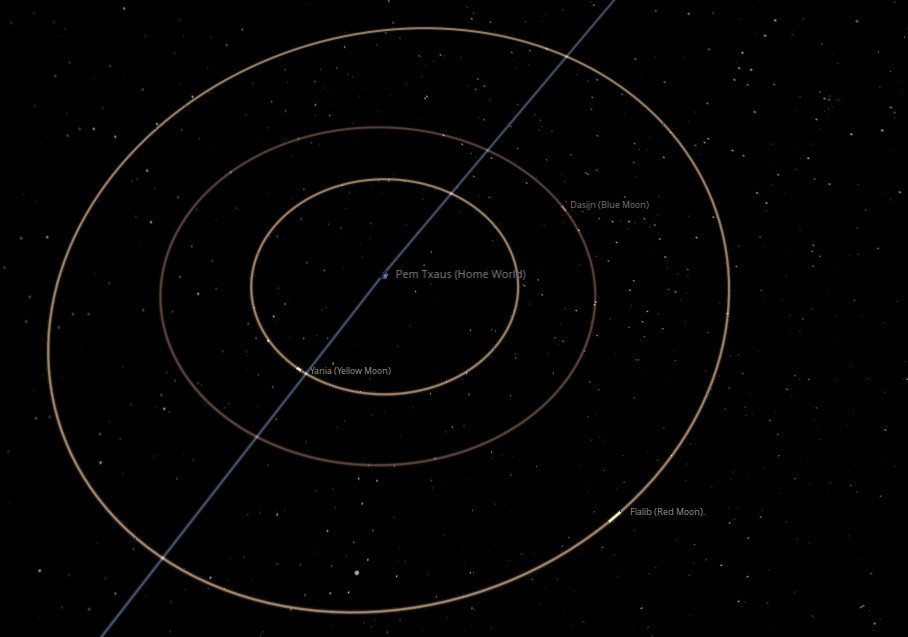
The moons of Xania, Dasjin, and Flalib travel in complex orbital paths around the world of Kom Txaus, shaping not only the tides and calendars but the very nature of magic itself.
Over three thousand years ago, the young elven astronomer Ellinary authored the first known treatise exploring the connection between the moons and sorcery. Through careful observation and calculation, she determined that Xania measured approximately 1,818 til my’aakal across, with a mass of 1.3 til gomr, completing its orbit in roughly 33.9 di’nik. Dasjin, larger at 2,280 til my’aakal, weighed 1.7 til gomr and followed a longer cycle of 71.2 di’nik. Flalib, the largest of the three, spanned 3,680 til my’aakal, possessed a mass of 2.61 til gomr, and required 115.3 di’nik to complete its circuit.
Yet Ellinary discovered a fatal flaw in conventional celestial theory. By all known laws of motion, three moons of such size and proximity should have long ago collided with one another, crashed into the planet, or been flung into the void. Something fundamental was missing.
Her dissertation proposed a radical solution: an invisible binding thread—a force neither physical nor purely arcane—linking Kom Txaus to its moons. This unseen tether stabilized their orbits and, more importantly, served as the conduit through which magic flowed into the world. Without it, she claimed, sorcery itself could not exist.
The magical guilds denounced Ellinary’s conclusions as heresy and placed a bounty upon her life. None ever claimed it.
More than a millennium later, during the reign of Reetta, Ellinary published a second paper. In it, she asserted that the widespread decline in enchantment use had weakened the planetary bond. As a result, the moons were slowly drifting outward, explaining why they appeared smaller than in ancient records. She further demonstrated that lunar calendars were no longer precise, requiring the insertion of an extra day every few years to remain aligned with observable phases.
At first, her claims were mocked. Within a decade, however, astronomers, natural philosophers, and scholars across multiple disciplines reached the same conclusion.
Tides, Cycles, and Convergence
The presence of three moons produces tidal forces of extraordinary magnitude, following a predictable yet intricate rhythm.
-
Xania and Dasjin share the night sky for approximately one week every 112 di’nik.
-
Xania and Flalib appear together briefly, roughly twice each year.
-
Dasjin and Flalib align after a separation of about 17 months.
-
Roughly once every nine years, all three moons rise together, painting the heavens in overlapping hues and triggering powerful magical and environmental effects.
In certain coastal regions, the difference between high and low tide can exceed eight my’aakal. Cities respond in different ways: massive sea walls, permanent water-warding enchantments, or settlements carved into cliffs well above the high-water mark, with roads descending to the exposed seabed at low tide.
Periods of maximum lunar brilliance also coincide with increased volcanic activity and seismic unrest. The most devastating tsunami in recorded history followed a massive earthquake south of Vamonamo, where a towering wave erased nearly two-thirds of the surrounding population.
Lunar Light and Living Things
The Thesilans taught humanity more than four thousand years ago that lunar light alters living matter. When plants are bathed in a moon’s glow, they often shimmer with its color, their natural properties temporarily enhanced. Anything brewed, eaten, or crafted from them during this period carries amplified effects.
This revelation unsettled the mage guilds. Potion-makers, healers, and even ordinary folk could produce powerful elixirs without understanding a single arcane principle—simply by harvesting at the right time. During these luminous phases, people gather ingredients for medicine, food, and ritual use alike.
As the moon wanes or sets, the enhancement fades, and the plants return to their ordinary state.
Calendar Reference (Year 2694)
-
my’aakal = meter
-
til my’aakal = kilometer
-
til gomr = kilogram
-
ta’luat = 2
-
tu’nal = 20
-
til = 1000
-
di’nik = one planetary day (one full rotation of Kom Txaus)
On the Concordance of the Three Moons and the Necessity of the Unseen Bond
by Ellinary of the High Observatories
(Declared Heretical. Circulation Prohibited.)
Primary Text (Ellinary)
I set down these measures not to challenge the gods, but to reconcile what is seen with what must be true.
Xania measures 1,818 til my’aakal across, possessing a mass of 1.3 til gomr, and completes its circuit in 33.9 di’nik. Dasjin spans 2,280 til my’aakal, weighs 1.7 til gomr, and completes its course in 71.2 di’nik. Flalib, greatest of the three, measures 3,680 til my’aakal, bears a mass of 2.61 til gomr, and completes its revolution in 115.3 di’nik.
Yet these numbers do not agree with motion alone.
If governed solely by visible forces, the moons would long since have fallen upon the world, collided with one another, or been cast into the void. Their continued harmony demands an additional constraint—one neither seen nor measured by ordinary means.
I therefore assert the existence of an unseen binding thread connecting the moons to the world itself. This bond stabilizes their courses and provides the conduit by which sorcery enters the realm. Should this tether fail, magic would diminish, then vanish entirely.
Margin Note — High Guild Astronomer Teyras (Year 412)
Speculative metaphysics. Introduces non-material forces without proof. Recommend censure.
Ellinary (continued)
Further observation suggests the strength of this bond is not constant. As enchantments fall into disuse, the thread weakens. The moons drift outward—slowly, but measurably—appearing smaller than in the records of our ancestors.
This drift disrupts the lunar calendars. Correction by intercalary days is required every few years to maintain alignment between phase and season.
That such correction is now necessary is not coincidence. It is evidence.
Margin Note — Archivist Selunne (Year 519)
Calendar drift confirmed. Cause uncertain. Author’s conclusion remains… troubling.
Ellinary (continued)
The tides bear further witness. With three moons, their rise and fall exceed what any single satellite could impose. In certain regions, the waters withdraw more than eight my’aakal, returning with equal violence.
These forces follow a pattern:
-
Xania and Dasjin share the sky on a repeating cycle.
-
Xania and Flalib meet more rarely.
-
Dasjin and Flalib align after a long separation.
-
At greater intervals, all three rise together, and the world responds.
Earthquakes multiply. Volcanoes awaken. Magic surges, uncontrolled and abundant.
Margin Note — Natural Philosopher Korrin (Year 733)
Tidal amplification verified. Triple-rise interval miscalculated here; later refinements suggest a longer cycle.
Ellinary (continued)
The Thesilans taught that living things respond to lunar light. Plants exposed during peak brilliance take on its hue and potency. Those who consume or distill them inherit the effect—whether mage or commoner.
This truth has been concealed, for it removes exclusivity from magic.
Yet it is observable, repeatable, and undeniable.
Margin Note — Guild Alchemist Maravel (Year 812)
Annoyingly correct. Unauthorized harvests continue despite sanctions.
Ellinary (final passage)
I do not claim the bond was forged by mortal hands. Only that it exists, and that it can weaken.
If the moons ever break free, magic will fade—not with a scream, but with silence.
Let those who read this decide whether that future is desirable.
Later Scholarly Marginalia (Collected Edition)
“Ellinary erred not in principle, only in precision.”
— Astronomer-Royal Hestivar, Year 1129
-
Orbital periods refined; deviations confirmed.
-
Outward lunar drift measured independently across three observatories.
-
Intercalary calendar days standardized by royal decree.
-
Triple-moon convergence recalculated to approximately nine-year cycles, with variance caused by the weakening bond.
“Magic does not cause the bond. The bond permits magic.”
— Anonymous Thesilan hand, ink composition non-human
“This dissertation remains banned not for being false, but for being inconvenient.”
— Scribe’s note, erased twice, rewritten once